
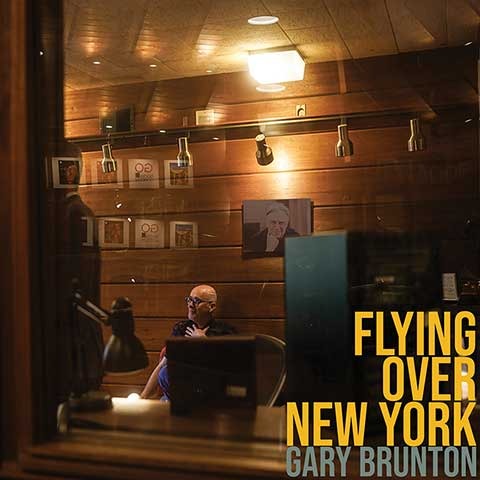
After taking the bus in Night Bus and Second Trip, the train in Trên Dydd and Gwawr, and then a spaceship in Spacecraft, Gary Brunton now travels by plane to New York to record in a reknowned studio.
The highlight of this journey takes place in Englewood Cliffs, New Jersey. It is under the legendary roof of Van Gelder Studios that the trio, featuring Jeremy Manasia (piano) and Charles Goold (drums), choose to record a new album of Gary’s original repertoire.
Stepping into the RVG studio is akin to following in the footsteps of John Coltrane and Herbie Hancock. Under the guidance of Maureen Sickler, heir to the Van Gelder sound, and thanks to the expertise of engineer Katsuhiko Naito, Gary Brunton seeks to achieve an organic and cohesive album, caracterized by a deep, pure acoustic sound of the trio.
Release date: November 20, 2026 – PRE-SALE NOW – DELIVERY IN PREVIEW (shipping mid-october)


Gary Brunton in a New York trio for a new album recorded in a mythical studio
Double bassist and composer Gary Brunton announces the release of his new album titled Flying Over New York. For this project, he surrounds himself with two major talents of the current American jazz scene, pianist Jeremy Manasia and drummer Charles Goold. Together, the trio delivers a work of great narrative maturity, guided by the subtle and demanding artistic direction of Clovis Nicolas.
A musical odyssey through transport and time
For several years, Gary Brunton has been building a singular body of work, creating a series of jazz compositions inspired by various means of transport. Audiences have followed him by coach in his albums Night Bus and Second Trip, then by train with Trên Dydd and Gwawr, and finally aboard a spaceship with the album Spacecraft. This time, the musician takes flight by plane to New York, marking a new conceptual step in his discography.
The climax of this great journey takes place in Englewood Cliffs, New Jersey. It is under the legendary roof of the Van Gelder Studio (RVG) that the trio chose to record this original repertoire. To step into this sacred temple of jazz is to walk directly in the footsteps of universal giants such as John Coltrane and Herbie Hancock. Under the direction of engineer Maureen Sickler, a true heir to the Van Gelder sound, and thanks to the fine expertise of engineer Katsuhiko Naito, Gary Brunton sought and captured an organic clarity and a rare acoustic depth.
Through the eleven tracks: tales of creation and benevolent ghosts
Each composition reveals personal stories, long-standing friendships, and vibrant homages to the tutelary figures of jazz.
The record opens with Retrouvailles in Central Park, a composition initially created in 2021 and recorded on the album Second Trip alongside Bojan Z and Simon Goubert. Gary Brunton met pianist Jeremy Manasia for the first time in New York in 1992. During the summer of 1993, the latter came to visit him in Paris to spend two weeks playing and exploring the Parisian jam sessions. In April 2026, exactly 33 years later, the two friends reunited in New York and adapted this piece into a 7/4 meter especially for the occasion.
Next comes Diggin Dolphy, a title born from a striking childhood memory around 1984 in Burnley. In front of the family television set with his father, Gary Brunton discovered the alto saxophone of Eric Dolphy during a jazz night on the BBC. Initially unsettled by Dolphy’s atonal improvisations, the bassist learned to savor his boldness and energy over the years. Since Eric Dolphy recorded several cult albums in this New Jersey studio, notably Out to Lunch in 1964, Brunton conceived this melody through singing, improvising freely in his spirit. The framework for the piano improvisation revolves around a Db blues while the double bass solo unfolds without any harmonic restriction.
The track Rising Damp featured on the previous quintet album, Spacecraft. It is a warm dedication to the great bass/double bass player Steve Swallow. During a Carla Bley Big Band concert in Paris in 2003, Gary Brunton was able to give a copy of his very first album, French Cricket, to Steve Swallow. A month later, the latter sent him a particularly warm and encouraging reply. This piece is directly inspired by his universe, and more particularly by the famous composition Falling Grace, over which Brunton superimposed an entirely new melody.
Did He Eckers Like borrows its title from an expression typical of the North of England which means “Of course not”. The composer challenged himself to write a piece in the key of Bb major at a particularly brisk tempo. He asked drummer Charles Goold to improvise an introduction to set this fast tempo. After the exposition of the theme, the improvisations unfold on the classic structure of an AABA form corresponding to the Rhythm Changes (I Got Rhythm) chords.
The story behind My Piano Joy goes back to the year 1990. It was after playing a series of concerts with a variety singer in Paris that Gary Brunton was able to buy his very first upright piano. This instrument followed him through five moves and saw the birth of a hundred pieces. At the beginning of 2026, the musician had the opportunity to buy a new piano of a higher category. It was while playing around for the first time on this new instrument that he composed My Piano Joy, a simple melody carried by the pure beauty of the piano sound.
Million Dollar Ears is rooted in a 2011 commission for the large orchestra Pee Bee, where Brunton had written a suite dedicated to Charles Mingus. A trio version of Mingus’ House was recorded in 2021 with Bojan Z and Simon Goubert. The story also connects to the American singer Sheila Jordan, with whom Brunton shared the stage in 2004 and 2017. Sheila Jordan was a close friend of Mingus and Charlie Parker, and it was Parker himself who threw her the historic line: “Ah, you’re the one with the million-dollar ears”. Sheila Jordan recorded her very first album in Rudy Van Gelder’s studio in 1962 with Steve Swallow on double bass. Gary Brunton intended to invite her onto this new recording, but the singer unfortunately passed away in August 2025 at the age of 96. To pay tribute to her and celebrate her majestic life, the initial ballad was transformed into a kind of festive samba.
The title Tommy and George refers to pianist Tommy Flanagan and double bassist George Mraz. As a student in Wales in 1986, a Welsh friend handed Gary Brunton a cassette of the recording Eclypso, and he experienced a real musical shock upon hearing George Mraz’s playing. He saw him in concert in 1989 in Paris, then in 1992 in New York at the Sweet Basil club within Tommy Flanagan’s trio. Since Tommy Flanagan’s album Jazz Poet was recorded in this same studio by Rudy Van Gelder in 1989, Brunton seeks here, with Jeremy Manasia and Charles Goold, to rediscover the unique complicity that united these two missed musicians.
The album also features a personal interpretation of the standard Autumn in New York by Vernon Duke, magnified by the trio’s approach.
Good Shalt Prevail is a waltz composed in 2022 and found on the 2023 quartet album, Trên Dydd, featuring French saxophonist François Jeanneau. Through this melody, the composer seeks to send a deeply positive message. In the face of the different wars, injustices, destructions, and sufferings affecting the world, Gary Brunton expresses the intimate certainty that one day peace will be restored and that good will ultimately prevail.
The track Henry Grimes salutes another immense double bassist who recorded multiple times at the Van Gelder studio during the sixties, notably alongside McCoy Tyner and Roy Haynes. After a short free double bass solo introduction followed by a theme played rubato, the trio heads towards an Eb blues. This is a direct historical nod, as it was also in this studio that John Coltrane recorded his famous Eb blues, Bessie’s Blues, in 1964 on the album Crescent. Gary Brunton wanted to celebrate here all the qualities of a complete musician endowed with a powerful sound, an iron tempo, and a total mastery of the bow.
Finally, the album closes with Wednesday Night Bebop in Accrington, a fast and intense theme anchored in the spirit of Hard Bop and torrid swing, offering an ideal playground for Jeremy Manasia to express himself on a modal grid. The title finds its origin with a lot of humor in the town of Accrington, located in the north-west of England. The piece is inspired by the universe of pianist Herbie Hancock, and more particularly by the album Speak like a child, recorded in this studio on March 9, 1968, the day Gary Brunton was born. It is the ironic story of a bassist from the town of Burnley who boasted everywhere that he played demanding bebop every Wednesday night in a club in the neighboring town of Accrington, when it turned out he was unable to swing a simple tune.
By blending the demands of New York jazz with the poetry of his personal stories, Gary Brunton delivers with Flying Over New York an album that is at once virtuoso, inhabited, and deeply human. Borne by the immediate complicity of an exceptional trio, this recording already stands out as a major and warm milestone in the double bassist’s discography.
Retrouvailles in Central Park
Diggin Dolphy
Rising Damp
Did He Eckers Like
My Piano Joy
Million Dollar Ears
Tommy and George
Autumn in New York
Good Shalt Prevail
Henry Grimes
Wednesday Night Bebop in Accrington
All compositions by Gary Brunton
Published by Éditions Amoc
Except « Autumn in New York » by Vernon Duke published by Warner Chappell Music Corp
Gary Brunton (Double Bass)
Jeremy Manasia (Piano)
Charles Goold (Drums)
Produced by Jazz En Face
Session producer Clovis Nicolas
Recorded by Maureen Sickler at Rudy Van Gelder Studio
Mixed and mastered by Katsuhiko Naito
Additional recording and mastering by Yohan Progler at Green Home Studio
Photographs by Mariana Meraz and Clovis Nicolas
Graphic Design by Corinne Garino
Released by Juste Une Trace
With support : SCPP | SACEM
Release date : 20-11-2026